
South Carolina Marriage and Divorce Custodians
South Carolina assigns each product to a specific office. The elected county Probate Court accepts a marriage application, issues the license after the required wait, records the returned certificate, and preserves the original county record. Family Court hears divorce cases, while the county Clerk of Court maintains the complaint, orders, docket, and decree. The South Carolina Department of Public Health Vital Records receives state copies and produces certified vital-record products. A DPH divorce report is not the full Family Court file or decree.
Quick Reference:
Original marriage license or a new license: Probate Court in the county of issuance.
State marriage certificate: DPH Vital Records for covered years.
Divorce case file and decree: Family Court and the Clerk of Court in the filing county.
State divorce report: DPH Vital Records, which does not hold the complete case file.
| Record | Original Issuing / Filing Office | Certified Copy Source |
|---|---|---|
| Marriage license and return | County Probate Court | Issuing Probate Court for the original county record |
| Marriage certificate | DPH receives the state copy | DPH for covered years or issuing Probate Court |
| Divorce petition and case file | County Family Court | Clerk of Court in the filing county |
| Divorce decree or report | Family Court decree; DPH state report | Clerk for decree, DPH for certified report |
South Carolina Marriage License Rules
Marriage applications go to a county Probate Court, not the Clerk of Court. State law requires a sworn eligibility statement with the applicants' full names, ages, and residences. At least 24 hours must pass after application before the license may be issued. The Probate Court may set local appointment, identification, Social Security form, payment, and fee procedures, so applicants should check that office's current instructions before appearing.
After issuance, an authorized officiant completes the ceremony and the signed certificate returns to the issuing Probate Court. The court records the return and sends the state copy within 15 days after return. South Carolina stopped recognizing newly formed common-law marriages prospectively after Stone on July 24, 2019, although an older relationship may require a fact-specific legal determination.
Apply for a South Carolina Marriage License
Choose a Probate Court and verify its local process. County rules affect appointments, accepted identification, supplemental forms, fee amount, and payment method. The state-required wait cannot be shortened merely because plans changed.
- Select the county Probate Court and confirm whether an appointment or online pre-application is required.
- Bring the identification and local forms listed by that Probate Court.
- Provide the sworn names, ages, residences, and other requested eligibility details.
- Pay the county-specific license fee by an accepted method.
- Wait at least 24 hours after applying before the license is issued.
- Use an authorized officiant and return the completed certificate to the issuing Probate Court.
South Carolina Marriage Application Fields
The sworn state eligibility statement calls for core identity and residence facts. Probate Courts can require local identification and administrative forms as well. Applicants should use legal names that match their proof of identity and ask the court how to address prior names or record corrections.
| Field | Required | Notes |
|---|---|---|
| Full name | Yes | Use the legal name supported by identification. |
| Age | Yes | Part of the sworn eligibility statement. |
| Residence | Yes | Provide each applicant's current residence. |
| Identification | Local procedure | Confirm accepted government-issued documents. |
| Social Security form | Local procedure | Ask how protected information must be supplied. |
| Prior-name or marriage details | As applicable | Follow the Probate Court's current form. |
South Carolina Marriage and Divorce Fees
DPH charges a nonrefundable search fee even when it finds no record. County marriage-license, divorce-filing, copy, and certification totals depend on the current office schedule. Before mailing any request, confirm the exact amount, payee, payment instrument, identification, and return-mail requirements.
| Item | Amount | Where Paid |
|---|---|---|
| DPH search and first certification | $12 by standard mail | DPH Vital Records |
| Additional copy of same record | $3 | DPH, in the same order |
| Eligible expedited service | $17 search total | DPH eligible channels, not mail |
| VitalChek service | Posted $12.85 plus record and shipping fees | Authorized vendor; verify checkout |
| Marriage license or Probate copy | County-specific | Issuing Probate Court |
| Divorce filing or certified decree | County schedule | Family Court Clerk of Court |
Search South Carolina Marriage Records
DPH states that its marriage-certificate coverage runs from July 1950 through December 2023. Verify the rolling endpoint before ordering. For an earlier or later event, or for a copy of the original application, license, and return, contact the issuing Probate Court. Supply both spouses' full names, birth surnames or other married surnames when relevant, the date, and the issuing county.
The official DPH D-0639 application asks for the applicant's contact and mailing details, relationship to the parties, signature, event names, date, and county. It offers long-form or statement products. A current government, school, or employer photo ID is required; an application without acceptable ID is returned unprocessed.
Find South Carolina Divorce Records
A South Carolina divorce begins in Family Court. The filing county's Clerk of Court holds the complaint, summons, service entries, temporary orders, financial declarations, mediation or discovery filings, final order, and decree. Some material involving children, finances, or protected information may be confidential, sealed, or redacted. DPH's divorce report confirms the vital event but does not replace those Family Court documents.
South Carolina grounds include one-year separation and statutory fault grounds. Residency is generally one year when one spouse resides in the state, or three months when both reside here, but venue must be verified for the actual case. Rule 28 permits certain uncontested one-year-separation divorces limited to divorce and name change to proceed on affidavits and photo identification without a hearing. Custody, support, property, alimony, or fee issues require a hearing.
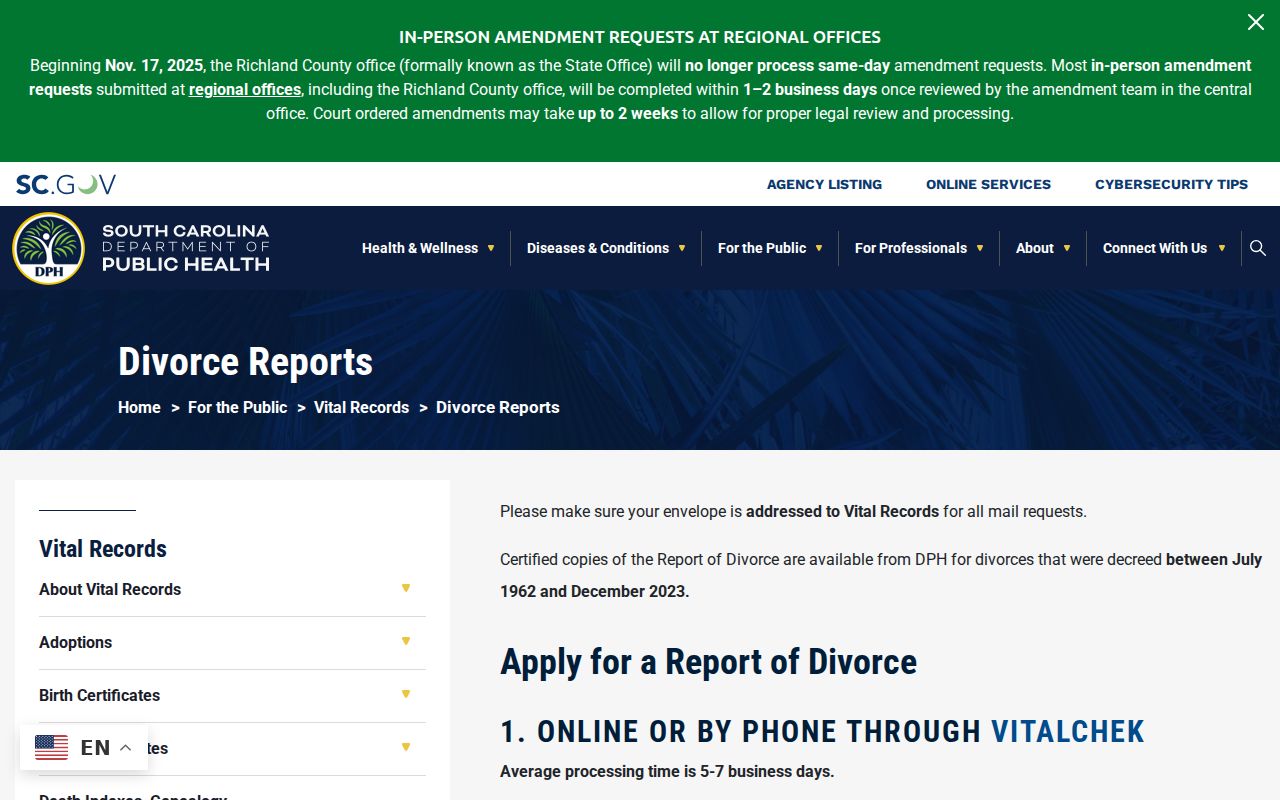
The official DPH divorce-report page explains eligibility and ordering routes. The image below reflects that separate state product, not a court decree.
A requester who needs the judge's signed decree or the full divorce file must still contact the Family Court clerk in the filing county.
Certified South Carolina Vital Records
First ask the receiving agency what form it accepts. DPH can issue the state marriage certificate or divorce report for covered events. Probate Court can certify the original marriage record, while the Family Court clerk can certify the decree and other public case documents. Eligible DPH requesters include a named person, adult child, present or former spouse, or legal representative for a named party.
The D-0639 form distinguishes a long form from a statement for both marriage and divorce. It also provides an alternative mailing addressee and asks a legal representative to identify the represented person. Mail orders require the current photo ID and a money order or cashier's check under DPH instructions. An incorrect product choice can produce valid proof that still fails to satisfy the receiving agency, so confirm whether that agency needs the state report, the original license, or the judge's decree before ordering.
- Choose the DPH product, original Probate record, or Family Court decree.
- Gather names, date, county, relationship, photo ID, and any legal-representative proof.
- Submit D-0639 by the current DPH route, or request the county document from its custodian.
- Pay the exact fee by the method that office accepts.
- Check DPH status only after its stated waiting point if the order has not arrived.
South Carolina DPH Vital Records
South Carolina Department of Public Health Vital Records handles state marriage certificates and divorce reports. Standard mail requests use D-0639 and a money order or cashier's check under current instructions. VitalChek accepts web and telephone orders. Posted research showed average vendor processing of five to seven business days and about four weeks for mail, but current estimates control. In-person and drop-off service was temporarily unavailable as of June 19, 2025, so verify before traveling.
DPH restricts certified products to eligible requesters and requires photo identification. The application carries a felony warning and asks the requester to state the relationship. For an order pending more than 30 days, research lists vrrequeststatus@dph.sc.gov and 803-898-3630 on weekdays. Those contacts concern the DPH order, not the county court file.
Vital Records vs. county court: DPH supplies a state certificate or report. Probate Court keeps the original marriage record, and Family Court keeps the divorce decree and file.
South Carolina DPH Vital Records
Marriage certificates and divorce reports
Mail, authorized vendor, and currently available service channels
803-898-3630
Find South Carolina County Records
Use the directory of all 46 South Carolina counties to reach the correct local custodian. Ask Probate Court for a marriage license, application, or return. Ask the Family Court Clerk of Court for a divorce docket, decree, or public case document. Give the names, approximate date, county, and requested copy type. For older files, ask about an offline archive rather than relying only on a web index.