
South Carolina Criminal Court Records
A criminal court record is the judiciary's file for one prosecution. In South Carolina, a county Clerk of Court holds General Sessions records for felonies and higher misdemeanors. The issuing Magistrates Court or Municipal Court holds many summary offenses, preliminary matters, traffic-linked offenses, and ordinance cases. The file can contain an arrest warrant or indictment, charge codes, appearances, motions, hearing entries, pleas, verdicts, count-by-count outcomes, sentence sheets, costs, and appeal events. It is different from an arrest record and the initial court charges, which begin with law enforcement and prosecutorial action.
Court level matters. General Sessions is the criminal division of South Carolina Circuit Court, while Magistrates and Municipal Courts exercise narrower summary jurisdiction. A case may start with a warrant and bond proceeding in summary court, then move to General Sessions after solicitor review or grand-jury action. The clerk's index tracks court activity, but police reports, victim material, and prosecutorial work product may remain with another custodian or be confidential. A name match alone does not prove identity. Compare the case number, middle name, charge, filing county, dates, and final order before drawing a conclusion.
Search South Carolina Criminal Records
The South Carolina Judicial Branch Case Records Search gateway links to the Public Index for every county and to participating municipal indexes. It is a routing gateway, not one merged criminal database. Coverage, images, and municipal participation vary. JavaScript, cookies, and pop-ups may be required. When a result is absent, search the correct venue directly through the South Carolina county directory, ask the issuing summary court, or contact the General Sessions Clerk of Court.
- Open the Judicial Branch gateway and choose the filing county or participating municipal court.
- Search by defendant name or exact case number. Try known aliases and spelling variants separately.
- Review each count, filing date, court, and docket event. Do not treat an initial charge as the outcome.
- Open available images, then identify any missing indictment, order, or sentence sheet by title and date.
- Request the document from the proper clerk and state whether a certified copy is required.
A court search and a criminal-history check answer different questions. The Public Index shows a source case docket and any public images loaded by that court. SLED CATCH, operated by the South Carolina Law Enforcement Division, provides a paid name-based history compiled from fingerprint-supported arrests and reported dispositions across the state. CATCH can connect events from several counties, but it is not a certified indictment, sentence sheet, or docket. It also does not search the sex-offender registry. Use the county file to prove what the court ordered.
Another official record source helps identify jurisdiction boundaries. The federal divisional structure shows how South Carolina counties are assigned in the U.S. District Court.
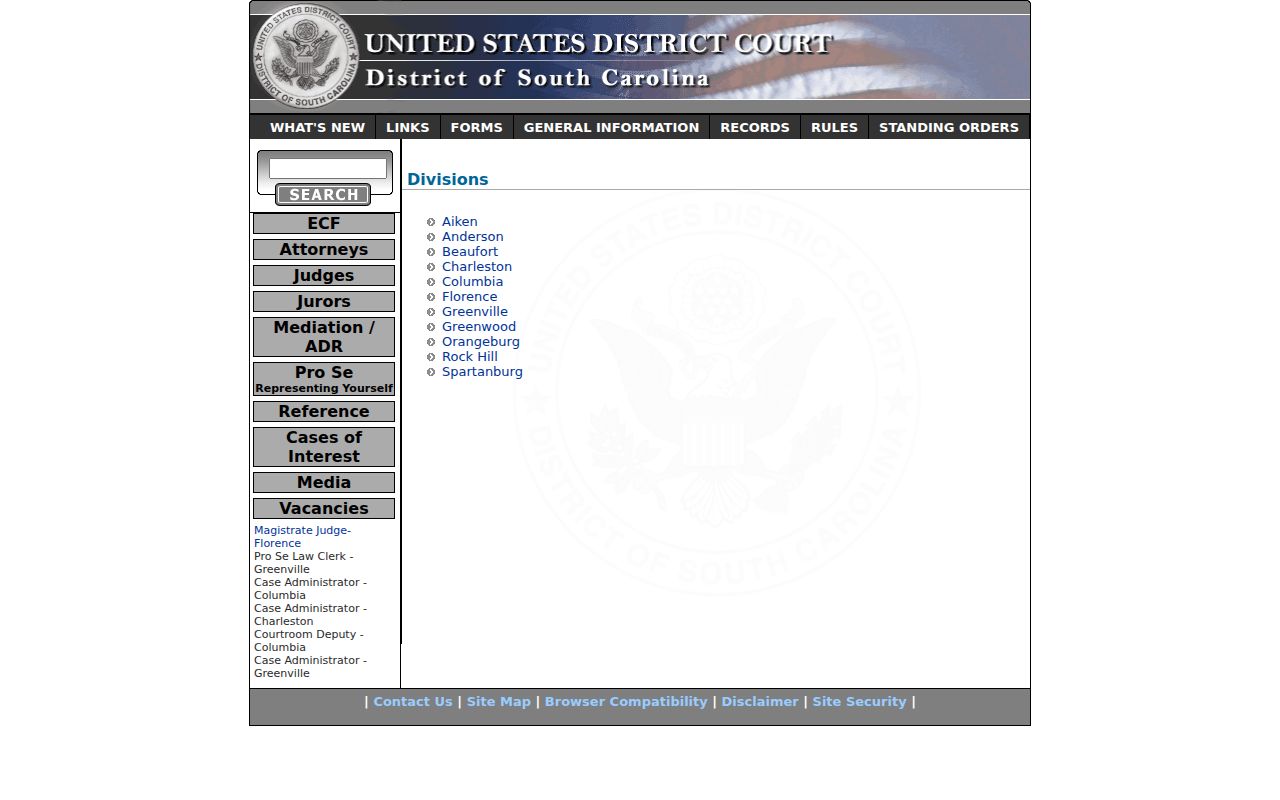
The captured division reference concerns federal cases, which do not reliably appear in the state Public Index. Use PACER or the federal clerk for a federal prosecution.
South Carolina Criminal Case Stages
Law enforcement first creates incident, arrest, fingerprint, photograph, and booking records. A bond or initial-appearance record may follow in summary court. The Circuit Solicitor then reviews serious allegations and may refuse, divert, amend, dismiss, or present them to a grand jury. A true-bill indictment is an accusation, not a finding of guilt. Once the case is active, appearances, pleas, motions, continuances, hearings, and orders form the docket. Discovery exchanged by the parties is not always filed or public.
Case flow: Charges Filed › Arraignment › Pretrial / Motions › Plea or Trial › Disposition › Sentencing
| Stage | What Happens |
|---|---|
| Arraignment | The charge and the defendant's formal response are addressed. A lawful waiver may permit a plea without grand-jury presentment. |
| Pretrial / Motions | Discovery disputes, suppression requests, competency issues, continuances, and other requests may produce docket entries and orders. |
| Plea or Trial | Each count can end by plea, verdict, acquittal, dismissal, nolle prosequi, diversion, or another authorized result. |
| Sentencing | The sentence sheet may state prison time, suspended time, probation, fines, costs, restitution, credit, and concurrent or consecutive terms. |
What South Carolina Criminal Records Show
South Carolina Public Index results commonly identify the county or agency, case number, filing date, defendant, counsel, solicitor, charge, CDR code or statute, offense date, warrant or indictment link, judge, bond, events, disposition, sentence, costs, and eligible images. Trial case numbers commonly use a year, court code, county code, and sequence. For example, GS identifies General Sessions. A docket label is only a summary. The signed order, judgment, or sentence sheet controls when shorthand and the document differ.
| Field | What It Shows |
|---|---|
| Case Number | Identifies the year, court type, county, and local sequence used to retrieve the source file. |
| Defendant | Shows the indexed legal name and may list counsel or aliases. It does not by itself establish identity. |
| Charges | Lists each alleged offense, CDR code or statute, and sometimes its warrant or indictment association. |
| Plea | Records the formal response to a count when entered, including guilty or not guilty. |
| Disposition | Reports the result for each count, such as conviction, acquittal, dismissal, diversion, or nolle prosequi. |
| Sentence | Summarizes punishment and financial terms; obtain the signed sentence sheet for authoritative detail. |
South Carolina Charges vs Convictions
A charge is an accusation. A conviction is a judgment of guilt after a plea or verdict. South Carolina police may arrest on several allegations, while the Solicitor may indict fewer or different counts. A multi-count case can contain a conviction, dismissal, and acquittal at the same time. Read every count and its final disposition. South Carolina does not use one universal felony-degree and misdemeanor-class grid, so quote the charged statute and its stated punishment rather than adding an invented class.
| Charge | Conviction | |
|---|---|---|
| Stage | Accusation before final judgment | Result after guilty plea or verdict |
| Proof | May begin from probable cause | Requires an adjudication of guilt |
| Meaning | Pending allegation unless resolved | Judgment of guilt on that count |
Read South Carolina Case Outcomes
Common status terms include pending, disposed, dismissed, transferred, stayed, closed, sealed, and inactive. “Disposed” means the court completed that phase; it does not always mean conviction or full payment. “Nolle prosequi,” often shown as nolle prossed, means the prosecutor chose not to continue that charge at that time. It is not a trial acquittal and does not prove automatic expungement. A no bill means the grand jury did not return the proposed indictment. Diversion may lead to dismissal and possible expungement after successful completion, but it is not a conviction.
Sentence data needs equal care. The docket may summarize imprisonment, suspended time, probation, fines, court costs, restitution, and credit. Separate counts may run at the same time or one after another. Online balances can lag after adjustment or payment. Request the signed sentence sheet or a certified ledger from the filing clerk when release calculations, licensing, or another consequential decision depends on exact terms.
Note: A motion filing shows that relief was requested; only the resulting South Carolina court order shows whether the judge granted it.
South Carolina Sealing and Expungement
Sealing restricts public access by judicial order. Expungement removes qualifying criminal records from public repositories under statute, subject to limited nonpublic uses. They are not the same as a pardon or appeal. Under Rule 41.1, a sealing request uses a prescribed motion and judicial review; filing a document does not make it secret. The official South Carolina expungement routes differ for General Sessions, Magistrates, Municipal Courts, and juvenile matters.
The official image below comes from the South Carolina Judicial Branch's Rule 41.1 source and illustrates that court-controlled sealing is a specific process.
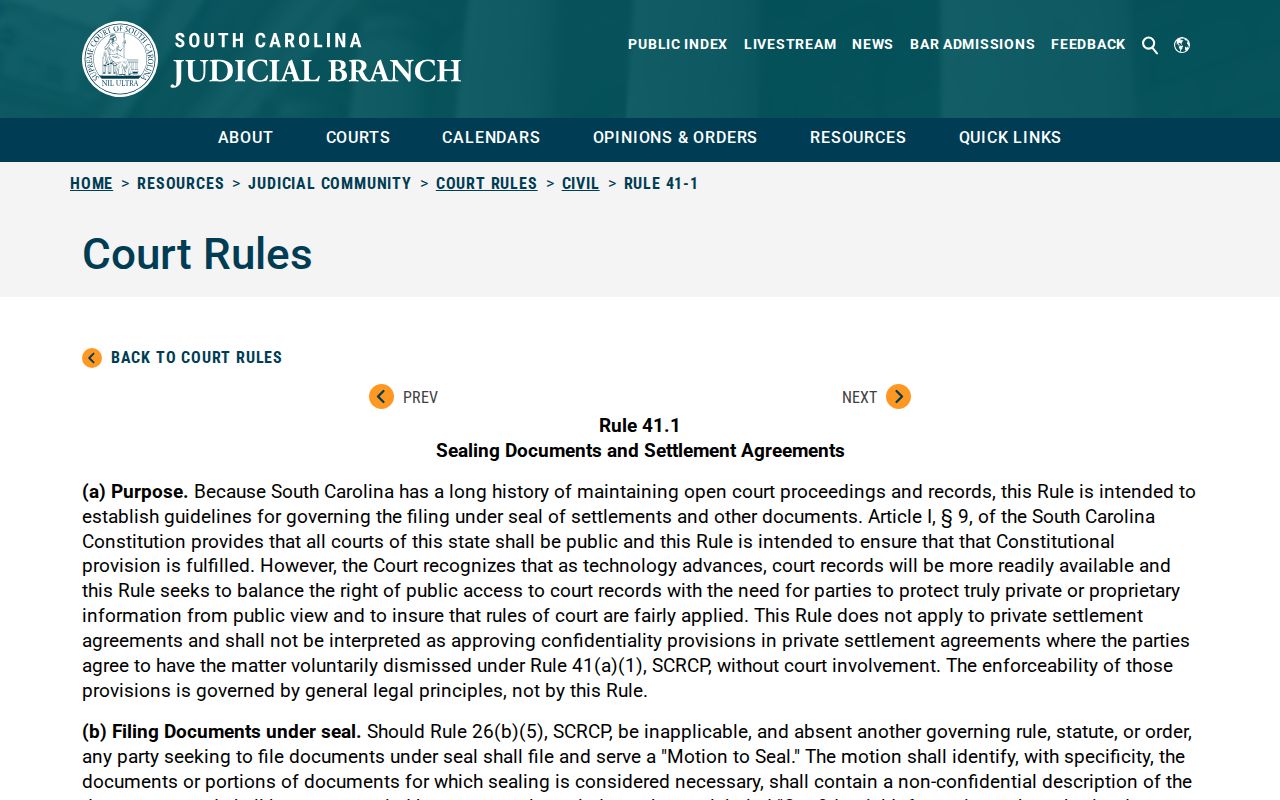
A sealed South Carolina criminal record may be unavailable electronically and at the counter without authority. Expunged information can still remain available for limited law-enforcement or statutory uses.
The Judicial Branch describes no-fee expungement for qualifying summary-court outcomes:
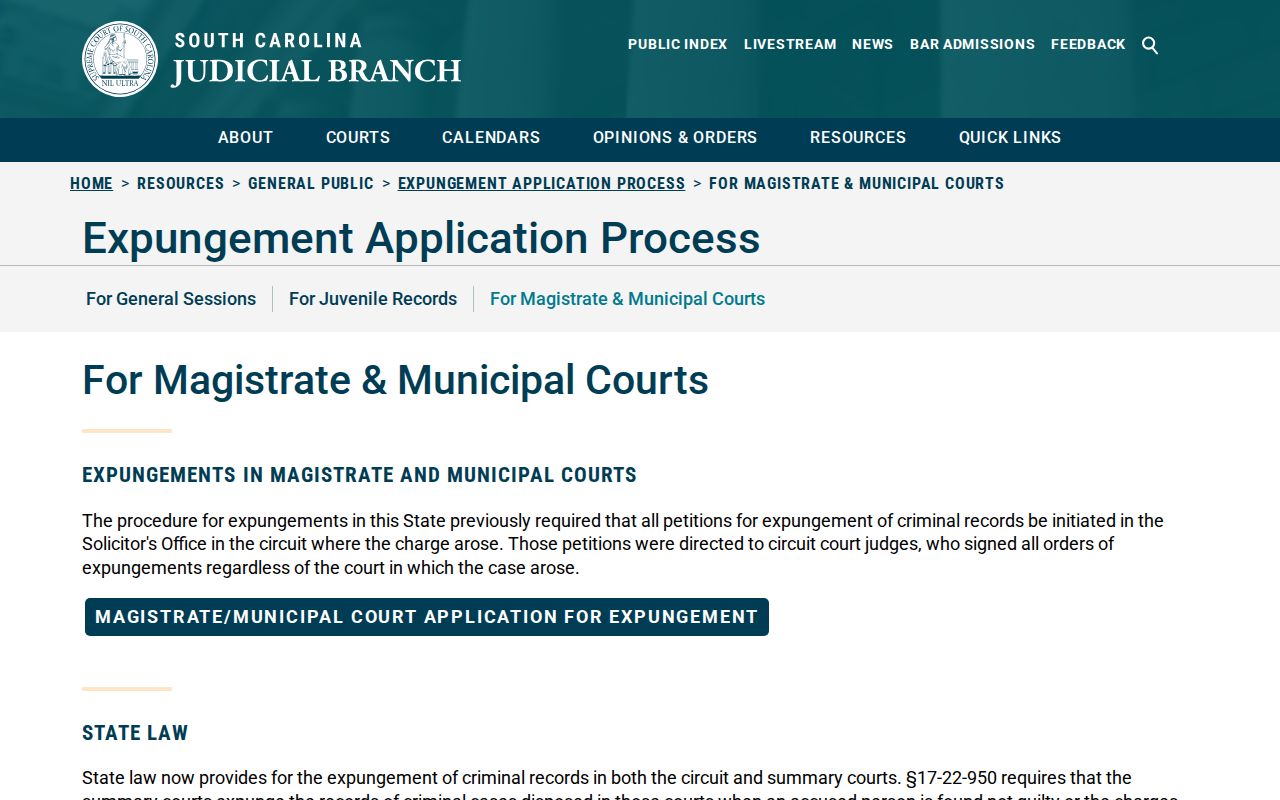
That route is limited to qualifying results and does not make every arrest, pending charge, or conviction eligible.
- Sealed
- Public access is restricted by court order after a motion and judicial findings. Authorized access may remain.
- Expunged
- Qualifying records are removed through a statutory route based on court, result, offense, and history. Limited statutory uses may remain.
Access South Carolina Criminal Records
S.C. Code Section 30-4-30 provides a right to inspect or copy public records subject to exemptions, response rules, and reasonable fees. Court access also follows Judicial Branch rules and the court's control of its own files. A request should name the case number, party, division, approximate date, and document. Ask for electronic copies when practical and specify whether certification is needed. The clerk supplies existing records; the clerk does not conduct legal research or create a new report.
Key Authorities:
South Carolina E-Filing Rule 10 keeps sealed material, confidential lists, and protected identifiers out of public electronic access.
S.C. Code Section 17-22-910 et seq. establishes uniform processing for qualifying criminal-record expungements.
South Carolina Criminal History Checks
CATCH accepts a subject's last and first names, with middle name, alias, date of birth, and secure identifying details available to refine a search. The standard report costs $25 and is nonrefundable. A posted service fee took effect July 1, 2026, so verify the current checkout amount. SLED also accepts its current mail form, payment, and a self-addressed stamped envelope. State at the time of order if a notarized or certified result is required. Ordinary name-based CATCH checks do not use fingerprints; regulated work may require a separately authorized fingerprint or FBI process.
The official SLED CATCH portal presents the statewide name-based report terms and ordering route:
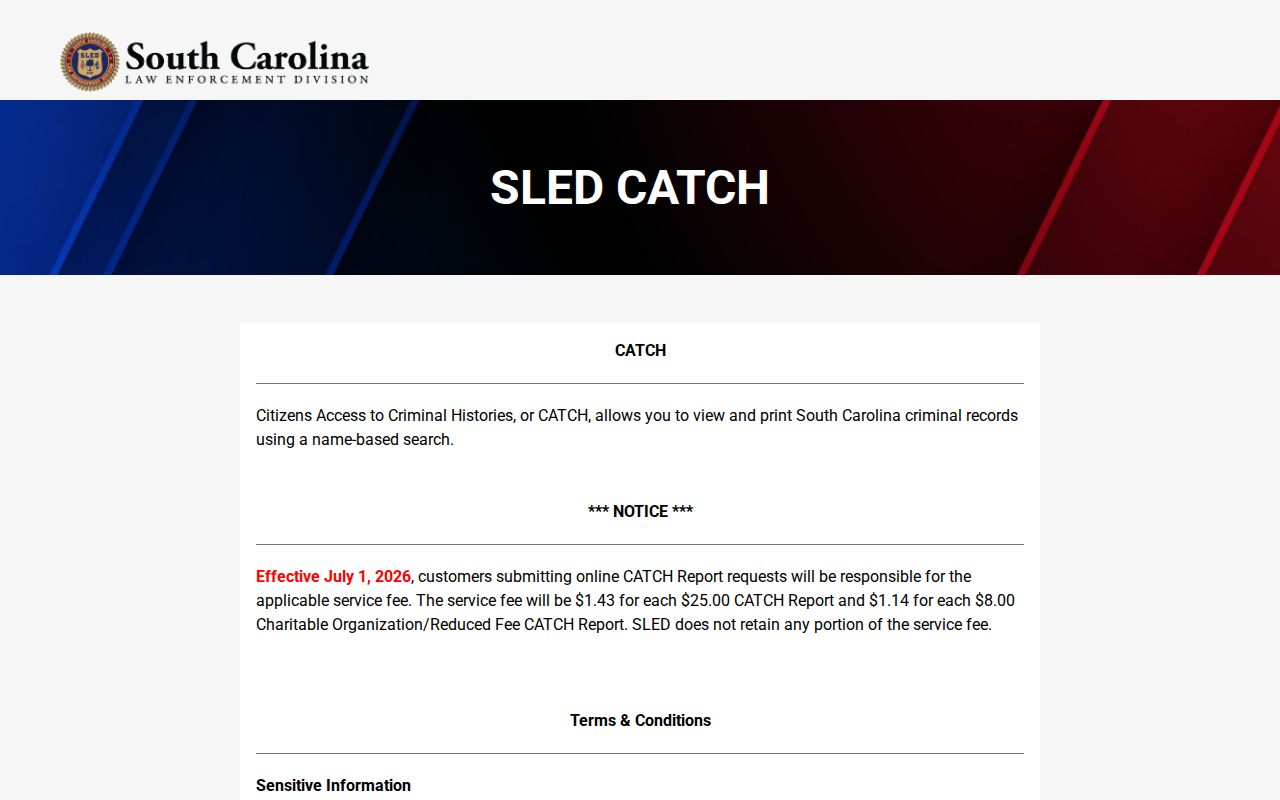
CATCH compiles reported criminal history, while the filing court remains the source for the controlling charge, disposition, and sentence documents.
A consumer report used for employment, housing, credit, insurance, or another regulated decision brings Fair Credit Reporting Act duties that do not attach to a casual public-record lookup. A court index can also be incomplete or stale. Confirm a reported disposition with the county source file and use a compliant provider when the federal law applies.
Important: This website is not a consumer reporting agency, and its information may not be used for an FCRA-regulated decision.
Restricted South Carolina Criminal Records
Juvenile records are confidential or disclosure-limited under S.C. Code Section 63-19-2010 et seq. Adoption and protected mental-health material are also outside ordinary public access. Sealed cases, sealed documents, and expunged matters may not appear in either the Public Index or CATCH. Filers must redact Social Security numbers, taxpayer identifiers, financial accounts, and protected minor information. Home addresses no longer display in new or existing Public Index cases as of January 1, 2026.
Online omission does not equal a clean history. Venue, spelling, municipal participation, record age, a seal, or a reporting lag can all affect results. Obtain the actual disposition from the offense county, then use that certified record to pursue any correction with the clerk or SLED. The county directory routes to all 46 South Carolina county sources.