
South Carolina's Unified Clerk Structure
South Carolina does not split general trial records between a district clerk and county clerk. Under S.C. Code sections 14-17-10 and 14-17-20, each county elects a Clerk of Common Pleas on a four-year cycle, and that officer serves ex officio as clerk of General Sessions, Family Court, and other courts of record unless another law provides otherwise. The same office therefore maintains major civil, criminal, and family files.
Unified does not mean every local record sits at one counter. The separately elected Probate Judge holds estates, wills, guardianships, conservatorships, and marriage licenses. Magistrates and Municipal Courts maintain their own summary files. A Register of Deeds function may be separate or combined locally, but deeds are not court case records. The right South Carolina clerk is chosen by jurisdiction, not by a broad request for “county records.”
South Carolina Clerk of Court
The Clerk of Court accepts pleadings, assigns case numbers, indexes parties and events, maintains the docket and official file, supports juries, receipts court money, issues certified copies, and transmits appellate records. Common Pleas material includes complaints, answers, motions, judgments, liens filed in cases, and civil appeals. General Sessions material includes indictments, pleas, motions, verdicts, sentence sheets, costs, and appeals. Family records include divorce, custody, and support matters, subject to stronger privacy rules.
- Common Pleas civil cases, judgments, and court-filed liens.
- General Sessions felony and higher misdemeanor cases.
- Family Court divorce, custody, and support dockets.
- Trial records transmitted for appellate review.
- Plain, certified, and exemplified copies of held files.
Clerk staff can locate records and explain office procedure but cannot give legal advice. The strongest request supplies a case number. When it is unknown, provide the full legal names, court division, approximate year, and document title. Search the county Public Index first, then ask about paper, microfilm, non-imaged, or archived files.
South Carolina Clerk Records and Duties
The unified Clerk of Court portfolio is broad but not universal. The table separates the clerk's own court records from files maintained by another elected court or local summary tribunal. That distinction matters when a name search fails. Moving the request to Probate Court, a Magistrates Court, a Municipal Court, or the Register of Deeds can be more effective than repeating a trial Public Index search.
| Record / Case Type | Clerk of Court Role | Correct Custodian or Duty |
|---|---|---|
| Common Pleas civil | Maintains docket and official case file | County Clerk of Court |
| General Sessions criminal | Maintains docket, indictment, disposition, and sentence record | County Clerk of Court |
| Family and divorce | Maintains file subject to access limits | Clerk of Court or Family Court office |
| Probate and estates | Not the ordinary trial-clerk file | County Probate Court |
| Marriage license | Not issued by the Clerk of Court | Issuing county Probate Court |
| Small claim or eviction | Not the ordinary trial-clerk file | Issuing Magistrates Court |
| City traffic or ordinance | Not the ordinary trial-clerk file | Issuing Municipal Court |
| Deed or mortgage | Not a court case record | County Register of Deeds function |
South Carolina Court Clerk Duties
A Clerk of Court serves both the bench and the public. Filings must be accepted, reviewed for administrative compliance, date-stamped, indexed, and placed in the official case history. The clerk receipts court costs and other payments, maintains judgments and financial entries, supports jury administration, issues authorized process, and prepares records for appeal. The office also manages access while honoring sealing, Family Court confidentiality, and redaction rules.
- Accept filings and assign statewide-format case numbers.
- Maintain the official docket, documents, judgments, and financial history.
- Issue authorized summonses, subpoenas, writs, and certifications.
- Collect and receipt filing fees, costs, fines, and other court money.
- Provide public inspection and plain, certified, or exemplified copies.
- Transmit the record when a case proceeds to appellate review.
Public access does not require the office to conduct legal research or create a new report. A requester should describe existing records. Administrative or non-case records may be requested under South Carolina FOIA, while judicial case files remain governed by court access rules and the court's inherent control. Neither route overrides a seal or protected juvenile, adoption, medical, or identifying information.
Request South Carolina Certified Copies
A certified copy bears the clerk's attestation or seal and confirms that the reproduction comes from the official file. A plain copy is useful for reading but lacks that formal certification. An exemplified copy adds judge and clerk authentication when another jurisdiction requires it. Courts, agencies, banks, and title professionals may specify the copy type, so ask the recipient before placing an order.
- Identify the filing county and exact court custodian through the county directory.
- Gather the case number, full party names, division, filing year, and exact document title.
- Contact the office to confirm the fee, payee, payment method, return envelope, and delivery options.
- Submit the request online, in person, by mail, or through an offered email or fax channel.
- Check that the delivered copy has the certification level the receiving institution requested.
An online absence is not a final answer. Staff can search non-imaged, paper, microfilm, or archived material. Name-only searches are weaker than a case number, especially after public home addresses were removed. Include variants and an approximate date, and ask whether another court or archive holds the file.
South Carolina Clerk Request Fields
No single statewide generic certified-copy request form was located. A focused letter or local form should give enough detail to find the existing record and price the order. Do not send a broad question that asks staff to decide a legal issue. Specify the item, desired format, and whether certification is necessary.
| Field | Required | Notes |
|---|---|---|
| Case Number | If known | The fastest and strongest identifier. |
| Party Names | Yes | Give both sides and name variants when possible. |
| Division and Year | Yes | Distinguishes Common Pleas, General Sessions, and Family files. |
| Document Requested | Yes | Name the judgment, decree, indictment, sentence sheet, or other item. |
| Copy Type and Quantity | Yes | State plain, certified, or exemplified and the number needed. |
| Requester and Return Address | Yes | Needed for quoting and mail delivery. |
| Phone or Email | Recommended | Lets staff clarify a file or fee question. |
South Carolina Clerk Fees
Public Index metadata is free, but South Carolina does not publish one generic statewide price for every plain, certified, or exemplified copy. County schedules control page, search, certification, archive, and delivery charges. Filing totals can combine statutory assessments, authorized local components, and technology fees. Confirm the current amount and payment method with the office before mailing funds.
| Item | Amount |
|---|---|
| Public Index metadata | Free |
| Plain, certified, or exemplified copy | County schedule; confirm page and certification charges |
| Common Pleas initiating action | Current filing assessment plus applicable local and e-filing charges |
| E-file summons and complaint technology fee | $25 |
| E-file magistrate civil appeal | $25 |
| E-file probate appeal | $25 |
| E-file foreign judgment | $15 |
| Indigency | Motion and affidavit; judicial approval required |
Approval to proceed in forma pauperis is not automatic and may not waive service, publication, vendor, or other outside costs. A mailed request should confirm the payee, accepted instrument, self-addressed stamped envelope, and refund practice. Do not assume a neighboring county uses the same schedule.
South Carolina Filing Forms
The Judicial Branch court-rules library organizes civil, criminal, family, probate, magistrate, evidence, appellate, alternative-dispute, and e-filing materials. The correct form depends on the court and request. County clerks may also publish local cover sheets, copy requests, or payment instructions through their own court sites.
- Case initiation and civil cover materials for Common Pleas filings.
- Family Court forms for the applicable domestic case and relief.
- Magistrates Court forms for limited civil and summary proceedings.
- Appellate notices and record-designation materials when review is sought.
- In forma pauperis motion and affidavit materials for a requested fee waiver.
Use only the current official version and follow the receiving clerk's instructions. A form does not establish that a filing is legally sufficient, and clerk staff cannot choose claims or prepare arguments for a party.
South Carolina Mail and E-Filing
The statewide eFlex system receives submissions for implemented courts and case types. An authorized e-filer is a South Carolina lawyer in good standing registered through AIS. A nonlawyer employee may hold a Firm Financial Manager account, but that role cannot e-file. The initiating filing and required fees are submitted electronically; the clerk accepts or rejects the submission, and the charge is finalized upon acceptance. The accepted electronic file becomes official, while legally required original wills, deeds, contracts, or exhibits must still be preserved.
Public users search the Case Management System Public Index, not an attorney eFlex account. Generally, documents filed or scanned from April 14, 2014 forward may display, while earlier images depend on clerk verification and publication. Confidential lists, sealed material, and protected items remain unavailable. Mail remains useful for certified copies and old files. Confirm the exact office, price, payee, payment type, and return method before sending a request.
South Carolina and Federal Clerks
Federal clerks and prosecutors are separate from South Carolina county clerks. The U.S. District Court for the District of South Carolina maintains federal trial dockets through CM/ECF and PACER:
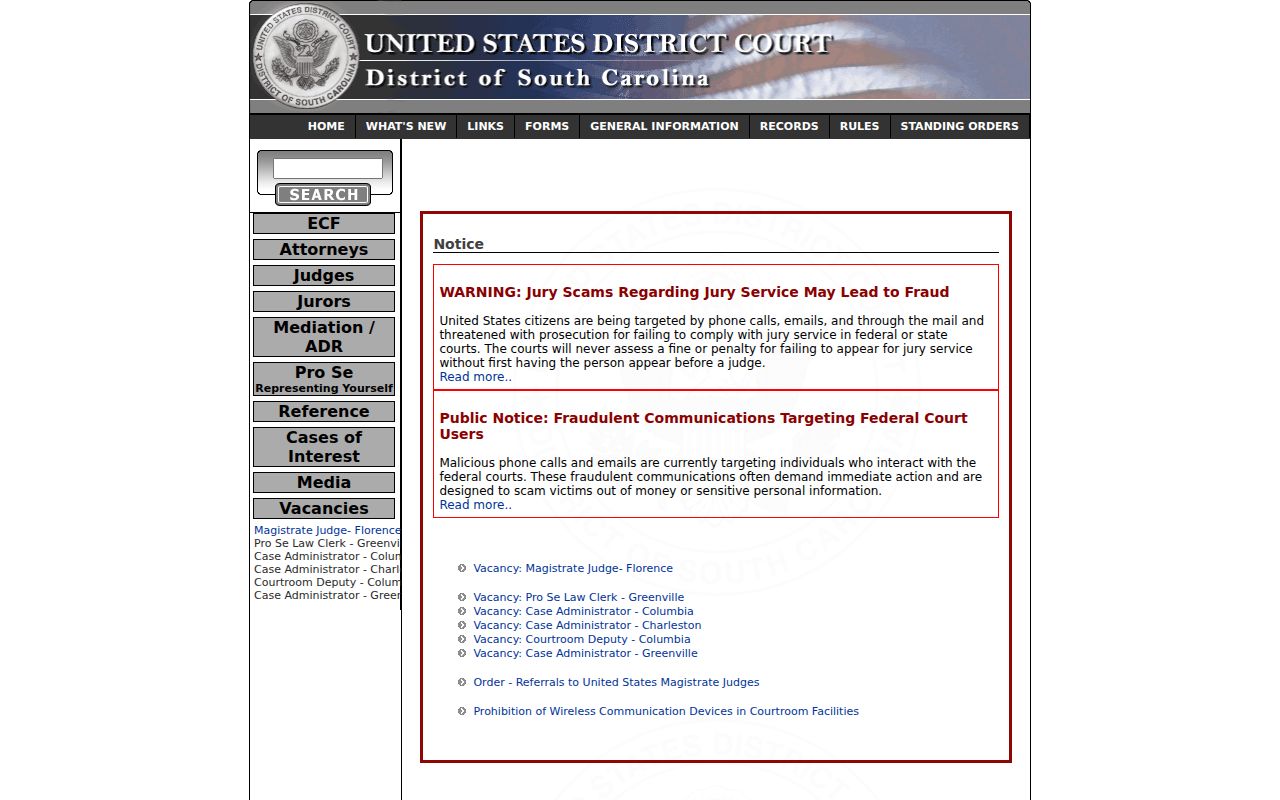
A federal filing will not reliably appear in a county Public Index, so direct federal record requests to the federal clerk.
The U.S. Attorney for the District of South Carolina is also a federal office rather than a South Carolina Clerk of Court:
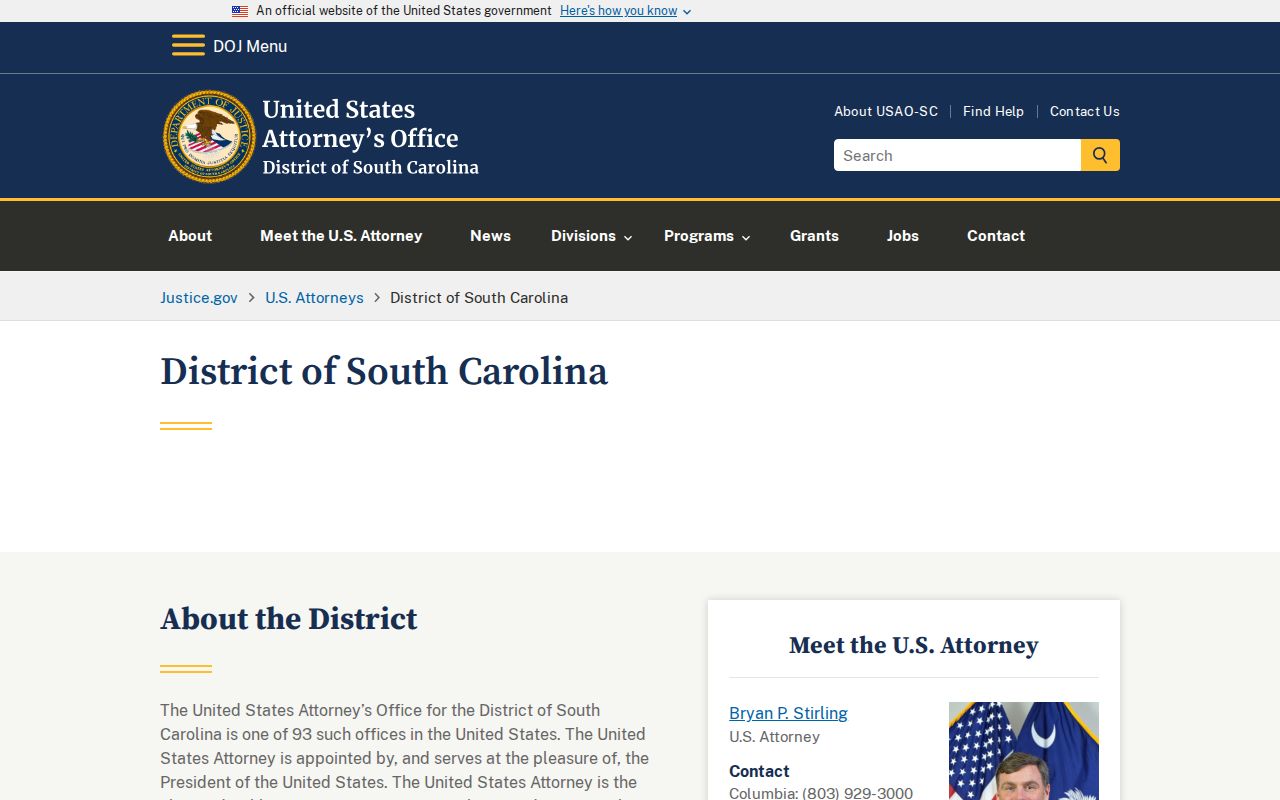
Prosecution information from that office does not replace the filed federal docket, and neither source holds a county General Sessions file.
Find South Carolina County Clerks
Use the full directory of all 46 South Carolina counties to reach the filing county's court site and current contact channels. Ask the Clerk of Court for Common Pleas, General Sessions, or Family records. Use Probate Court for estates and marriage licenses, the issuing Magistrates or Municipal Court for summary matters, and the Register of Deeds function for land records. Local pages supply addresses, hours, portal access, and copy instructions that should be verified before a visit or mailed payment.