
Two South Carolina Inmate Systems
County jails and South Carolina Department of Corrections prisons serve different custody stages. A sheriff's jail may hold a newly booked person, a pretrial detainee who has not posted bond, a person serving a local sentence, or someone waiting for transfer. SCDC holds people committed to state prison after sentence. Each of South Carolina's 46 counties controls its own roster or vendor, while SCDC maintains one official search for its current incarcerated population. Search both when the custody stage is unclear.
Neither system is universal. The SCDC search excludes released people, county sentences, probation, parole, community supervision, juveniles, and current SCDC fugitives. County rosters do not cover state prisons and can remove a name after transfer or release. Federal prisoners use the Federal Bureau of Prisons locator; federal pretrial detainees may be in U.S. Marshals or contracted local custody. Immigration and out-of-state custody require their own agencies.
South Carolina SCDC Inmate Search
The South Carolina Department of Corrections Inmate Search is the primary statewide prison locator. Its search application covers current sentenced and incarcerated SCDC inmates, with data stated as of midnight on the prior day. It does not cover county bookings or people released to parole, probation, or other community supervision. That exclusion is critical: an old sentence does not guarantee a current SCDC result, and a recent arrest will usually begin in a county jail instead.
The SCDC public search interface displays the official lookup fields and result route:
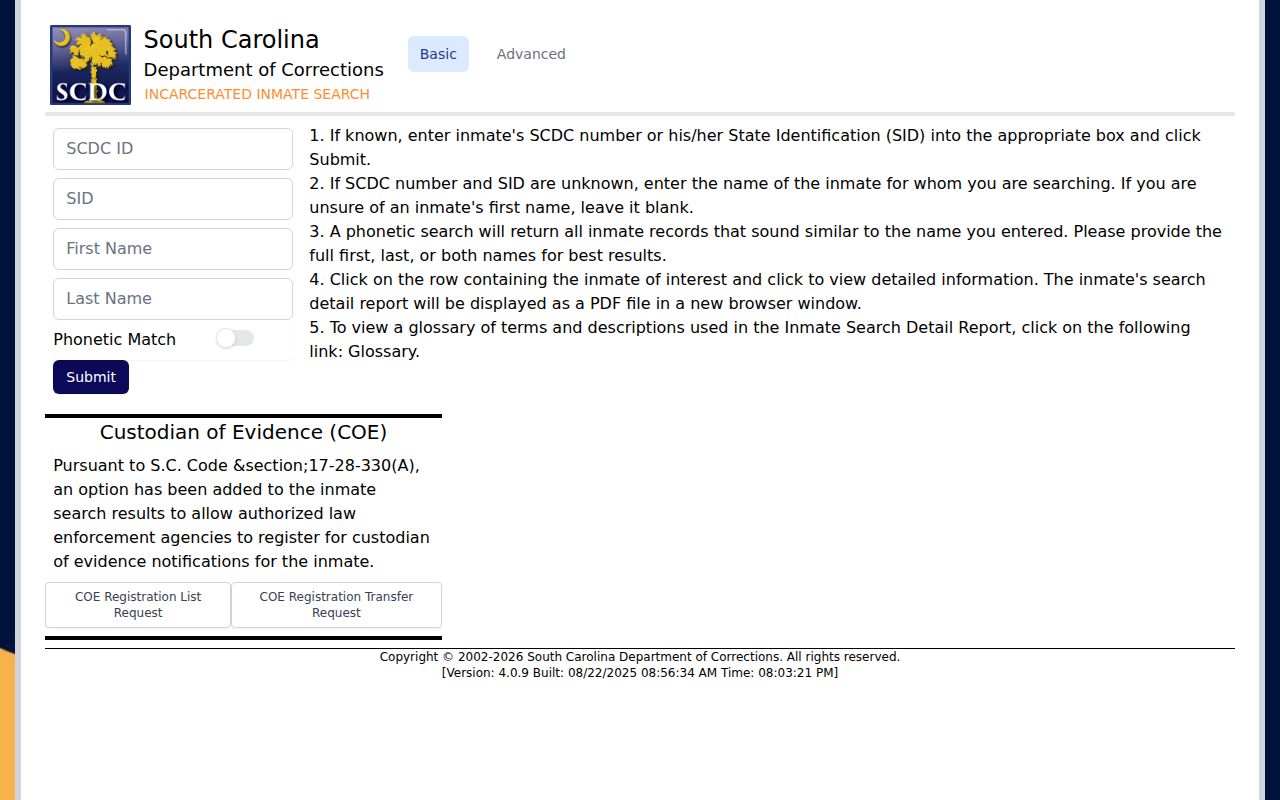
This interface is the state-prison search, so a county jail inquiry still begins with the arrest county's sheriff or detention center.
Search by SCDC ID when known because it is the most precise key. The application also accepts first and last name, SID where offered, and a phonetic-match option for spelling variants. SCDC provides a free information line at 1-866-727-2846. Report data errors through the agency's listed Ombudsman contact. Projected dates are informational and can change because of credits, detainers, orders, or parole action; they are not certified sentence calculations.
- Open the official SCDC disclaimer and continue to the agency's public search application.
- Enter the SCDC ID or SID if known; otherwise combine last and first name and try phonetic matching.
- Compare the name, photograph, identifier, demographics, and conviction county before choosing a result.
- Open the profile and confirm the current institution, offenses, sentence data, and published projected dates.
| Field | What It Shows |
|---|---|
| SCDC Number | The unique state corrections identifier used to distinguish people with similar names. |
| Current Institution | The SCDC prison shown as the person's present location at the stated data time. |
| Offense | Each published conviction tied to state custody, including conviction county where available. |
| Sentence Length | The court-imposed term reported for an offense; multiple terms require careful reading. |
| Projected Date | A release, max-out, or parole-related date when available, subject to later change. |
| Admission or Start | The published date associated with entry into SCDC custody or the sentence record. |
County jail vs. state prison: An absent SCDC result may mean county custody, release, supervision, juvenile or federal custody, a transfer, or a spelling mismatch. Search the county directory for the arrest county's jail roster.
The official South Carolina source for expungement routes by court type also shows why custody, a court case, and public criminal-record access are separate questions.
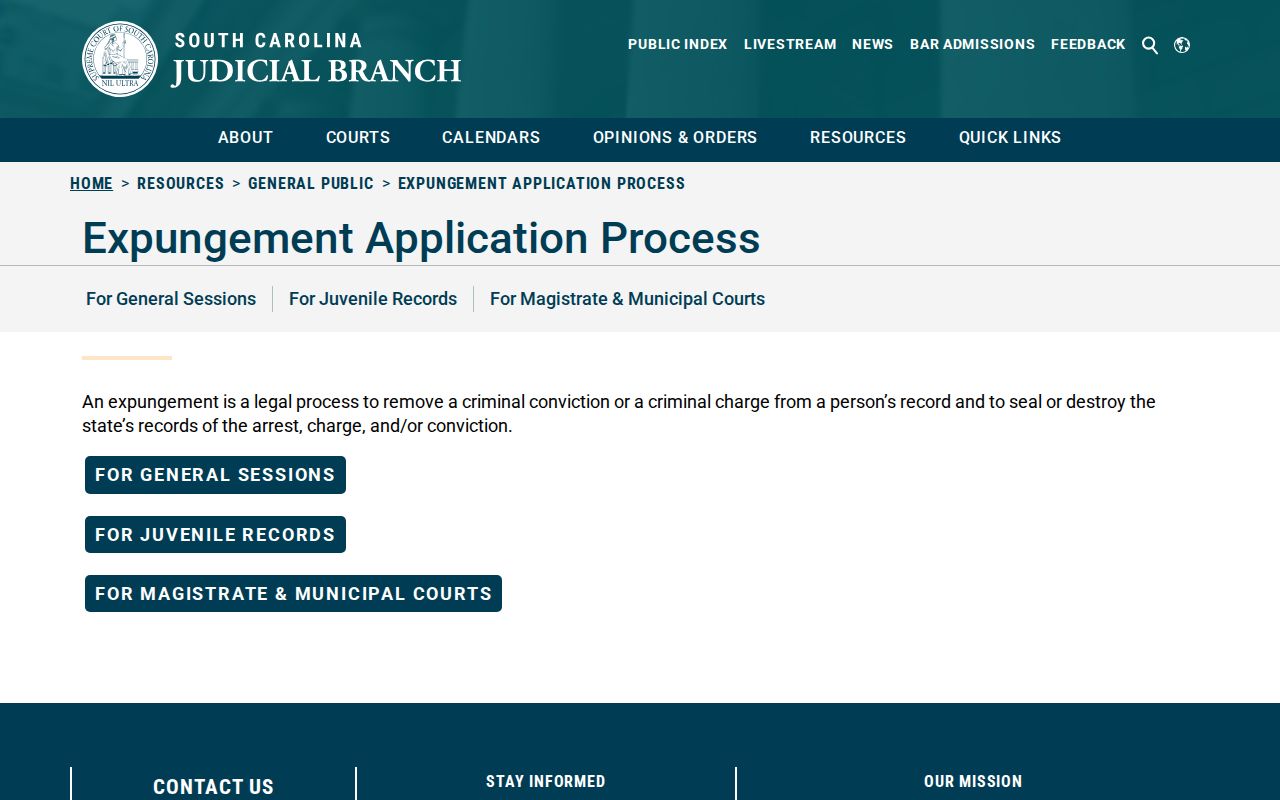
An expungement inquiry belongs with the correct court and Solicitor process. It does not alter a live custody record merely because an application was started.
South Carolina County Jail Rosters
South Carolina has no single statewide jail roster. Each county sheriff controls current booking access and selects its own website, app, phone process, or vendor. A roster may show recent arrests and pretrial detention, local sentences, holds, and people waiting for transport. Updates follow the county's schedule. Disappearance can mean release or transfer, not dismissal of a charge. Use the South Carolina county directory to reach the county tied to the arrest.
Search the arrest county first, then nearby counties when the booking location is uncertain. Call the detention center through its official number if a name does not appear. Ask whether the person was booked, transferred, released, or held under a different agency. A sheriff app is trustworthy only when linked or verified by the sheriff. For historical booking material, submit a targeted records request and expect redaction of medical, security, victim, and active-investigation information.
Find a South Carolina Inmate
Start with custody stage rather than sentence assumptions. A recent arrest points to the arrest county's jail. A known commitment to state prison points to SCDC. If neither works, check whether the person was released, transferred, moved to federal custody, detained as a juvenile, or recorded under a spelling variant. Use an identifier whenever possible. A matching name alone is not enough because profiles can share common names and similar ages.
- For a recent arrest, select the county and search its official roster by name or booking number.
- For a state-prison commitment, search SCDC by number or by first and last name.
- Compare identifiers, photograph, age or demographics, booking date, agency, and conviction county.
- Use South Carolina VINE for participating custody notifications, not as a court docket.
- Confirm the current location and all visit, mail, call, and funds rules with the facility.
South Carolina Roster Search Fields
Local South Carolina interfaces vary, and some rosters display a list rather than a form. Last name and first name are the common starting fields. A booking number can produce a more precise match. Some counties accept a date range or show current versus released status. Search aliases separately, avoid broad assumptions from a partial match, and contact the jail when its public portal does not expose enough detail.
| Field Label | Type | Required | Notes |
|---|---|---|---|
| Last Name | Text | Usually | Minimum characters and partial-match behavior vary by county. |
| First Name | Text | Varies | Use it to narrow common surnames; try formal names and aliases. |
| Booking Number | Text | No | Often the most precise local jail identifier when known. |
| Booking Date | Date | No | Some rosters use a date or range to separate repeated bookings. |
What South Carolina Jail Profiles Show
A typical county profile may include a mugshot, full name, booking number, age or limited date of birth, sex, race, physical descriptors, intake date and time, arresting or committing agency, facility, each intake charge and code, warrant or case reference, bond type and amount by charge, court, hold or detainer, and release status. Medical, victim, and security data remain excluded. “No bond” may mean bond has not been set. “Released” does not mean the charge was dismissed.
| Field | What It Shows |
|---|---|
| Booking Number | The local jail identifier for that intake, not a statewide case number. |
| Booking Date | When the person entered that facility for the listed custody event. |
| Charges | Intake allegations or codes, which may later differ from the prosecutor's filed counts. |
| Bond | Published type and amount by charge, subject to later judicial action. |
| Facility | The detention center or housing location made public by the county. |
| Release or Hold | A published release entry or another agency's detainer, when the county displays it. |
South Carolina County Jail Facilities
County detention arrangements are local, so one statewide address list cannot substitute for the sheriff's current facility information. A county may use a main detention center, another local facility, or transfer arrangements. Confirm the exact building before sending mail, scheduling a visit, or depositing funds. Address, phone, approved vendor, visitor rules, and hours can change independently of the roster.
The county directory routes to all 46 local records sites. Use the sheriff or detention-center link listed for the relevant county, then verify that the person is still housed there. South Carolina VINE can send release, transfer, escape, or other participating custody notices, but users with safety concerns should not rely on a notification service alone.
A separate official source, the South Carolina marriage certificate program, illustrates the broader rule that each government database has a narrow purpose.
Vital records cannot confirm custody, just as an inmate locator cannot supply an unrelated civil record. Use only the system that owns the requested record.
South Carolina Jail Booking Process
After arrest, the agency brings the person to a county facility. Booking commonly records identity, fingerprints, photograph, property, intake allegations, and arresting agency while staff conduct health and security screening and classification. Public roster timing varies, so the research supports no universal promise that a profile will appear within a set number of hours. An intake charge can later differ from the Solicitor's filed charge or grand-jury indictment.
Judicial bond review follows the governing charge and court authority. Conditions may accompany personal recognizance, cash, surety, or property bond. Serious charges can require a Circuit judge or result in restricted or no-bond status. Do not interpret “no bond” as a final sentence. Contact the court for the order and the detention center for the person's present release status.
The official South Carolina privacy rule helps explain why public profiles and case files omit protected identifiers.
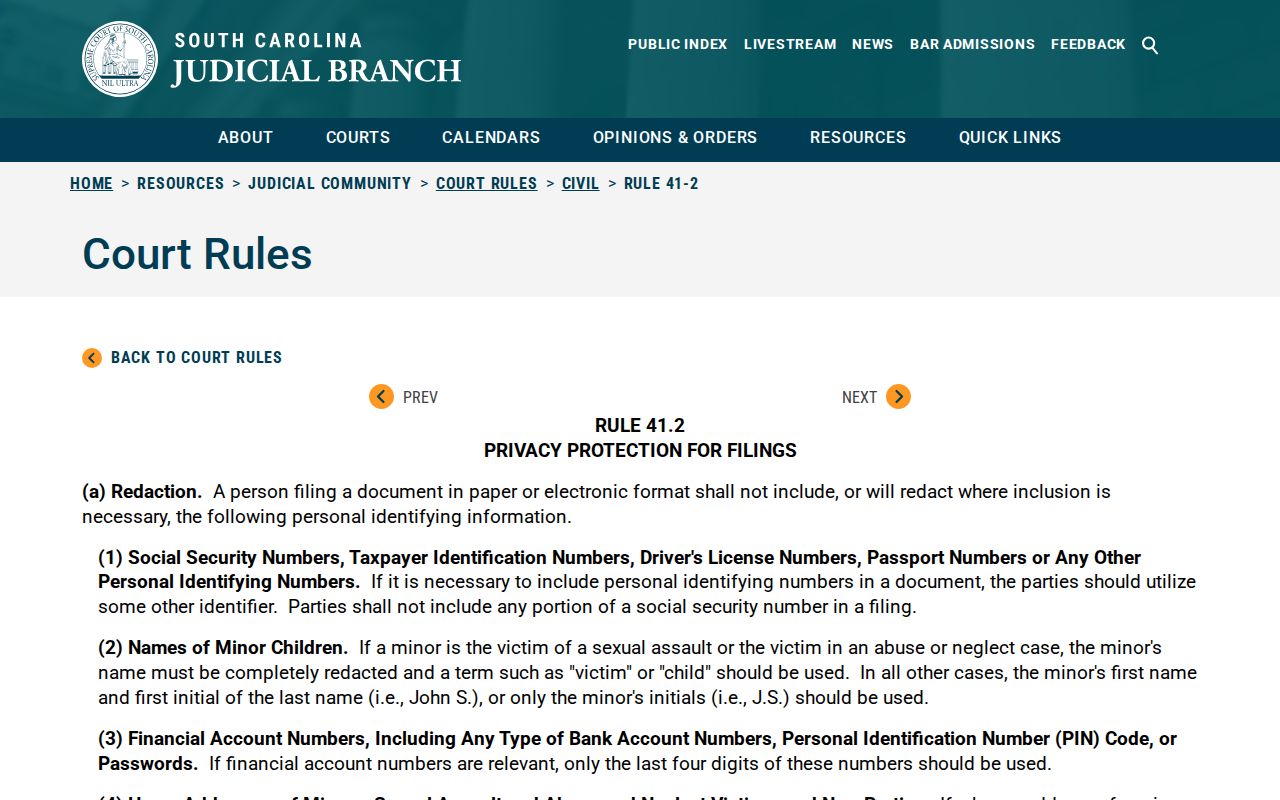
Public custody fields are deliberately narrower than the medical, classification, victim, financial, and security information held inside the facility.
South Carolina Inmate Visitation
Visitation differs between SCDC institutions and county jails. SCDC uses its own visitor approval, scheduling, identification, dress, conduct, and institution rules. Each sheriff separately decides county-jail schedules, visitor approval, in-person or video access, and restrictions. The table shows the questions to confirm, not fixed hours. Always check the facility through the county directory or SCDC shortly before travel.
- Weekdays: confirm approval, housing group, hours, and in-person or video format.
- Weekends: confirm reservation deadlines, visitor limits, hours, and identification.
- Holidays: check closures, reduced sessions, and special institution notices.
- Legal visits: attorneys should follow the facility's separate professional-visit process.
Contact South Carolina Inmates
SCDC mail requires the inmate's name and number plus the correct institution address. Unauthorized contents can be rejected. Calls use the agency's contracted monitored service except protected legal communications, and visits require approval and scheduling. County jails choose separate mail, telephone, video, and commissary vendors. Never assume the SCDC provider works for a sheriff's jail. Verify the recipient's current location, spelling, booking or SCDC number, mail format, and current vendor before paying.
For broader court context, CourtListener offers selected opinions and donated federal or state docket material.
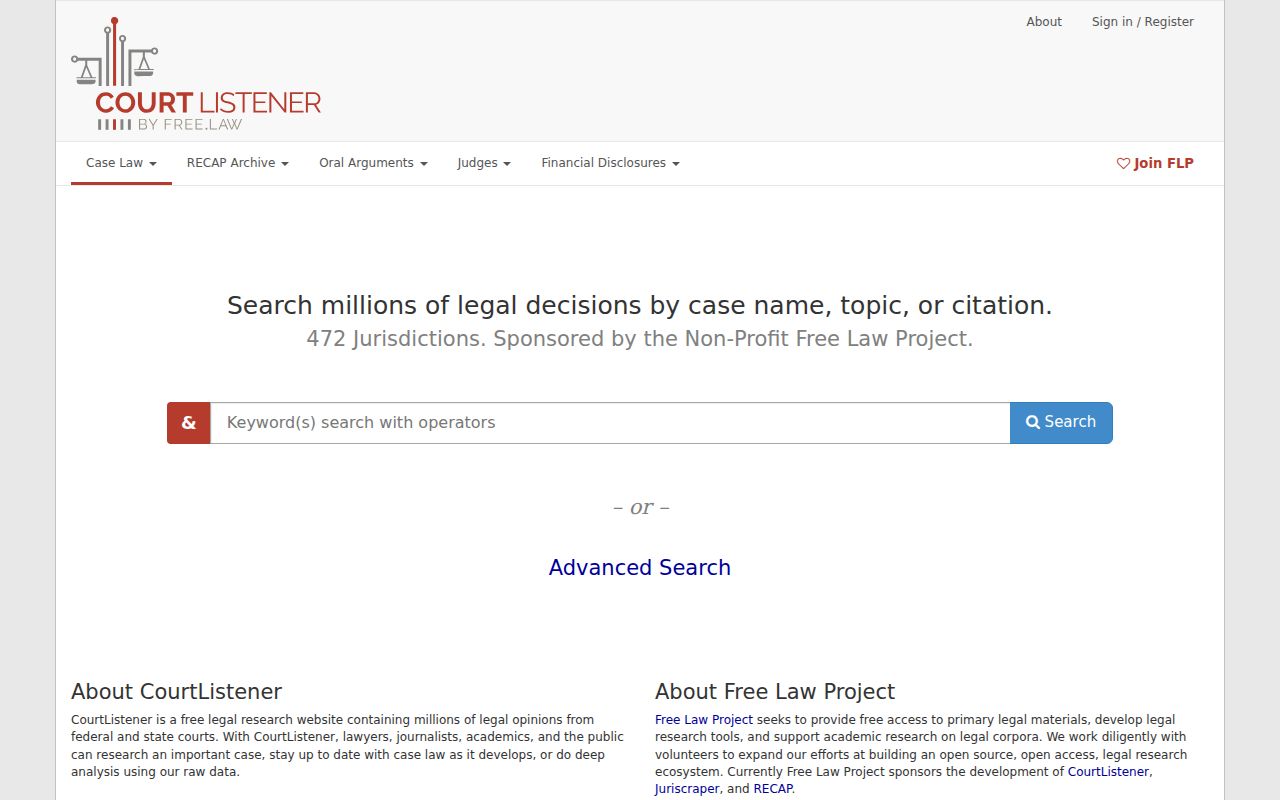
That archive is not a custody locator. Use it only for court documents, then return to the jail or SCDC source to confirm confinement.
South Carolina Inmate Funds
SCDC accepts funds only through its approved process. County inmate trust accounts use each jail's chosen vendor, deposit methods, limits, and fees. Confirm the official vendor from the facility website before entering payment details. Search ads and third-party pages can point to an old provider or the wrong jail. A transfer between county and state custody can also change the valid account and may require a new recipient identifier.
Federal custody is separate once more. The District of South Carolina PACER information describes federal court-record access.
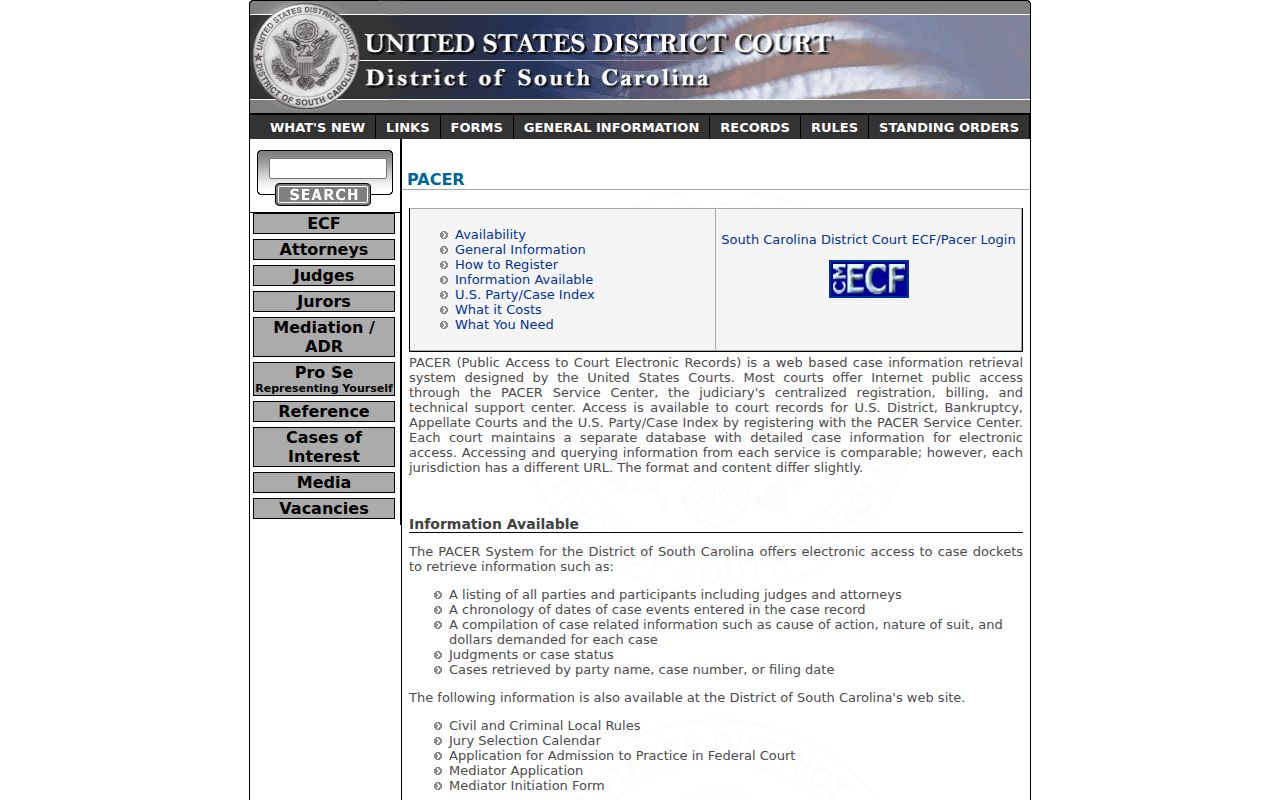
PACER can help locate a federal case, while the BOP locator or the U.S. Marshals custody channel is needed to locate a federal prisoner or detainee.
When every online search fails, call the relevant county detention center, check SCDC again after the next daily update, and review participating VINE custody information. Ask whether the person was transferred, released, booked under another name, or moved to another sovereign's custody. Historical custody may require a records request. Note: A jail release entry says only that custody ended there; it does not establish dismissal, acquittal, or completion of every hold.